The Build vs. Buy Decision for EUDI Wallet Connectivity
Author
Alexander Mikhailov
Date
October 16, 2025
TL;DR
The eIDAS 2.0 regulation mandates that banks must accept the European Digital Identity (EUDI) Wallet by 2027, requiring a complex integration that functions like a secure, multi-lingual translator for identity data.
A compliant connector requires deep expertise in Self-Sovereign Identity (SSI), advanced cryptography, and constant updates to evolving technical standards, capabilities rarely found in standard enterprise IT teams.
Building a solution in-house involves significant risks, including a 22+ month timeline for talent acquisition and development, and the long-term burden of maintaining specialized infrastructure.
Buying a specialized platform accelerates compliance to a matter of months, offers predictable costs through subscription models, and ensures continuous technical alignment with changing regulations.
Partnering with a vendor allows your internal teams to focus on core business innovation and customer experience rather than building non-core compliance infrastructure from scratch.
Just as banks utilize vendors for e-signatures and liveness checks, connecting to the EUDI Wallet is a specialized infrastructure need best handled by experts to reduce risk and total cost of ownership.
The new eIDAS 2.0 regulation is here, and with it comes a fundamental shift in digital trust for the entire EU. This isn't just another update, but a new rulebook. Soon, your customers will use a government-backed European Digital Identity (EUDI) Wallet on their phones to prove who they are.
In 2027, your bank must accept the new EUDI Wallet. The challenge isn't if you will connect to this new ecosystem, but how. This means navigating complex trust frameworks and integrating a new technology into your existing systems without causing major disruption.
This decision brings you to a strategic crossroads. Do you build a solution from scratch, or do you buy a platform built by experts? This article will help you answer that question by looking at which path gets you to compliance faster, with less risk, and at a lower total cost.
The Anatomy of a Wallet Connector: More Than Just an API
Connecting to the EUDI Wallet is not a simple software project. It's like building a secure, multi-lingual translator that can handle high-stakes conversations. A compliant wallet connector is a highly specialized piece of infrastructure. Below are the essential features it must have, why they matter, and the business risk you take if they are missing.
Feature
Why It Matters
What Happens if It's Missing?
PID and Credential Format Interoperability
While all wallets will be interoperable, they will use different formats for identity data (PID) and other credentials. Your system must understand and correctly handle all of them.
Your service will fail for customers from certain countries, leading to a frustrating experience and incomplete compliance.
Out-of-the-Box Technical Compliance
The solution must be built to the exact technical standards required for your organization to complete its official registration as a Relying Party.
Your organization will fail its formal registration process, facing regulatory risk and forcing a costly and time-consuming redesign.
Deep Understanding of SSI Principles
This goes beyond basic security. It requires deep expertise in the entire Self-Sovereign Identity (SSI) stack that powers EUDI Wallets: advanced cryptography, communication protocols, and credential formats.
The solution might not fully follow the official specifications, meaning your organization will not be compliant with eIDAS 2.0.
Seamless Systems Integration
The connector must feed verified data into your existing systems – like those for KYC, AML, or customer management – through modern APIs without forcing you to replace them.
You are forced into a costly and high-risk "rip and replace" of your core operational infrastructure.
Robust Security and Auditability
During your registration and future audits, regulators will demand detailed, unchangeable logs to prove your system is secure and operates by the rules.
You cannot prove compliance during an audit, which can lead to significant fines and damage to your company's reputation.
Scalability and Future-Proofing
The rules and technical standards under eIDAS 2.0 will change and evolve. Your platform must be built to adapt without constant, expensive re-engineering.
Your custom-built solution becomes outdated in 1-2 years, forcing you back into another expensive and urgent development project.
The "Build" Scenario: A Realistic Look at the True Cost
Building a solution in-house might seem like it offers total control, but it requires assembling a single, complex project team with two distinct groups of experts who must work in perfect sync.
The Strategic Group: This group includes Product Managers, Solution Architects, and Legal/Compliance professionals. Their job is to dive deep into the dense eIDAS 2.0 legislation and translate it into compliant user journeys, product features, and technical requirements. This team needs a rare mix of legal acumen and technical understanding.
The Technical Group: This is your engineering force. The challenge here isn't just hiring software engineers, it's finding the rare and expensive specialists with proven experience in Self-Sovereign Identity (SSI) and advanced cryptography. These skills are not typically found in enterprise IT departments.
This dual challenge of finding and integrating these experts into one team significantly impacts your timeline:
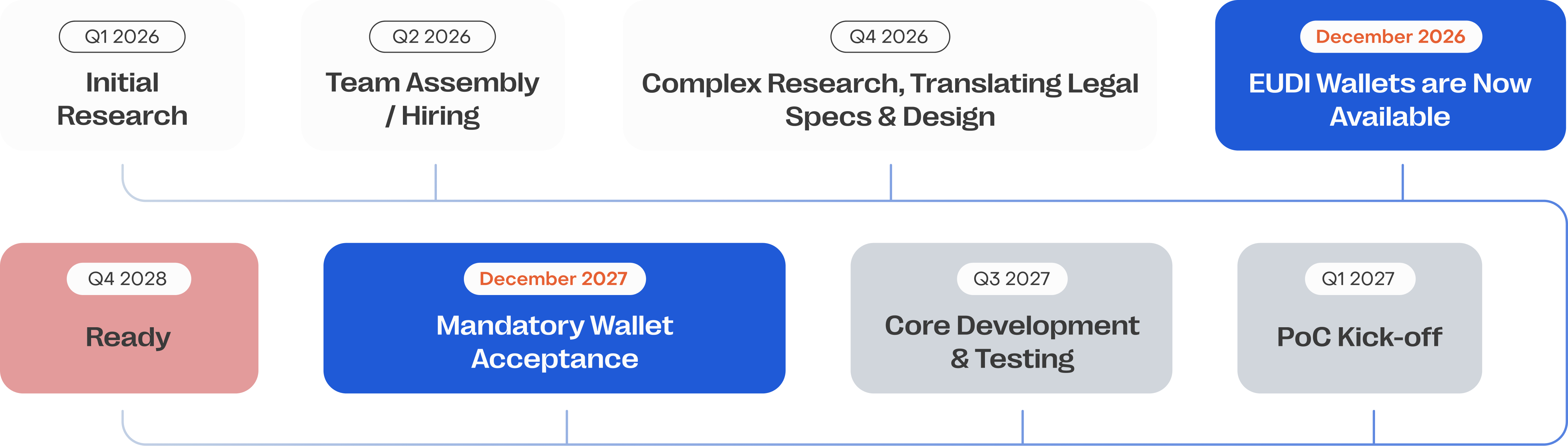
Months 1-3: Talent Acquisition & Upskilling. The hunt for or internal training of both strategic and technical experts begins. This alone can delay a project before it even starts, as you are competing for a very small pool of professionals.
Months 4-9: Research, Translation & Design. Your strategic experts must first become fluent in the regulation and then work to translate hundreds of pages of legal text into a clear blueprint for the engineering team. This is a critical and lengthy phase that is often underestimated.
Months 10-22: Core Development. This is over a year of dedicated engineering time spent building the complex connectors and verification engines based on the requirements from the strategic team.
Months 23-24+: Testing & Supporting Registration. After building, you face months of testing and providing technical support for your company's formal audit and registration.
Even after two years, the work isn't done. The "hidden costs" include retaining these expensive expert groups to maintain the system, continually update it as standards evolve, and support your organization’s re-registration audits. All this time, your best talent is focused on a compliance project instead of building products that serve your customers and grow your business.
[cta-wp-banks-playbook]
The "Buy" Scenario: The Path to Accelerated Compliance
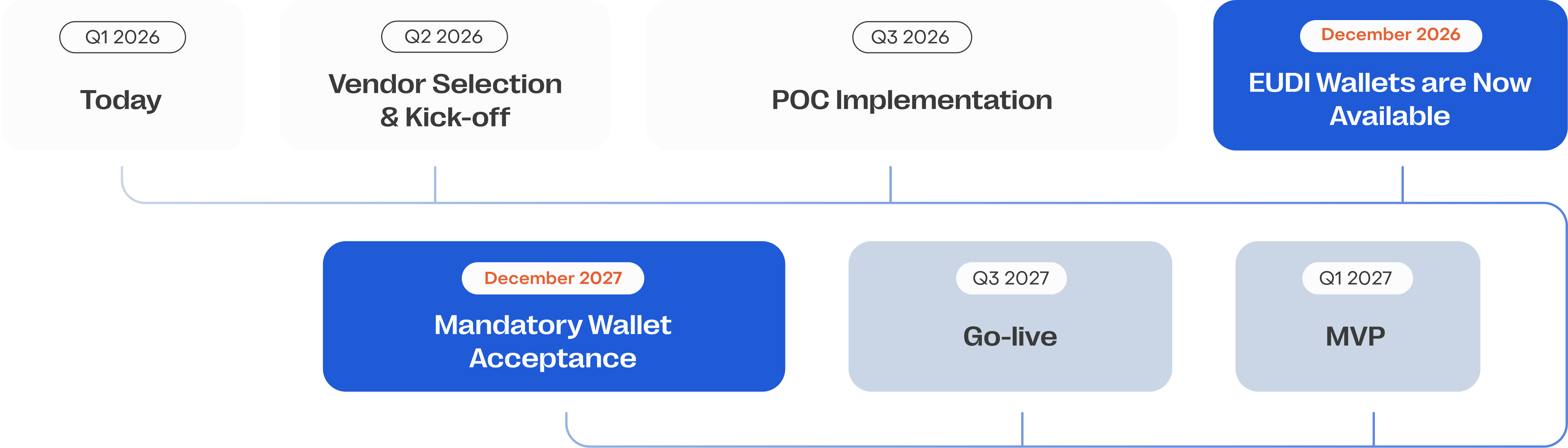
The "Buy" scenario completely changes this dynamic. Instead of building a complex team with two distinct groups of experts, you only need to assemble the Strategic Group.
This team can then focus on being a "smart buyer." They can evaluate vendors, select the best technical solution on the market, and oversee its integration. This allows you to leverage a ready-made platform from a specialized vendor and gain several key advantages:
Go to Market in Months, Not Years: You can use a pre-built platform that is already designed to meet the technical standards required by the regulation.
Predictable Costs: Instead of a high-risk, unpredictable project cost, you have a clear and manageable subscription fee.
Compliance as a Service: The vendor provides the deep technical expertise, taking on the responsibility of tracking changes in eIDAS 2.0 and updating the platform. This ensures you can maintain your registered status.
Focus on Your Core Mission: Buying a solution frees your internal teams to do what they do best: focus on your customers and your core business.
The Executive's View: Making the Final Decision
For leadership, this decision comes down to a few key business questions:
Total Cost of Ownership: What is the true 5-year cost of hiring, training, and retaining a specialized internal team versus a predictable license fee?
Risk Management: Where is the risk lower? With an internal team building a complex security product for the first time, or with a vendor whose entire business depends on getting this right?
Strategic Focus: Should your company be in the "wallet infrastructure business," or should you focus on your own industry?
This isn't a new decision, it's a familiar pattern. When GDPR arrived, you adopted specialized consent management tools. For PSD2, you integrated proven API gateways. You already rely on expert vendors for e-signatures, liveness checks, and remote identification. You don't build these critical, specialized systems in-house. Connecting to the EUDI Wallet is the next logical piece of this modern infrastructure stack to entrust to an expert.
Conclusion: Make the Strategic Choice
Building a compliant solution from scratch is a slow, expensive, and risky distraction from your core mission. Buying a specialized platform accelerates your path to compliance, dramatically reduces risk, and provides the strategic certainty you need to plan for the future.
Platforms like Truvity provide the essential "translation layer" that securely connects the new EUDI Wallet ecosystem to your existing systems, enabling you to meet your compliance obligations without a painful and costly overhaul.
With the 2026 budget cycle now underway, the time to make this decision is now. Ensure your roadmap is built on a foundation of certainty, not risk.
To help you make this crucial decision, we invite you to book a complimentary 30-minute eIDAS 2.0 strategy session with our experts. We can help you navigate the complexities and build a clear, actionable plan for your organization.


.svg)

.svg)